
Interview: Rich Bartlett, Loomio

Rich portrait beag

Loomio is a fascinating project. The web and the internet have fundamentally altered how people around the globe network and share information, but up until now these technologies have not much changed how people make democratic decisions together. Loomio is a new online tool that aims to fill that gap.

Loomio was created by a group of Occupy activists, social entrepreneurs, and software developers who met at Enspiral. Their aim was to create an open-source tool that would allow disparate networks of people to communicate, and then to turn that communication into radically democratic plans for action.

As such, Loomio might be an interesting tool for worker-owned start-ups who need an online space to communicate and to make decisions, but Loomio is also of interest because it is being developed by a group that is itself a worker-owned start-up, one that is structured as a radically democratic, horizontal cooperative.

To learn more about this cooperative and how they organize themselves, I spoke on the phone to Rich Bartlett, one of the founders.

Continue reading

Posted in Interviews | 2 Comments

Degeneration and Regeneration

Like all businesses, cooperatives can fail. Cooperatives can go bankrupt, but they can fail in another way too. Over time, cooperatives can degenerate. Cooperatives are said to degenerate when, under economic pressure, they abandon their cooperative principles and start adopting capitalist business practices and structures. In the worst case, given enough time and economic pressure, cooperatives can fully degenerate into privately-owned, capitalist businesses. Such businesses might still be economically viable ― they will have avoided bankruptcy ― but they can no longer be considered successful cooperatives.

This can easily happen. Cooperatives have been described as islands of socialism in a capitalist sea, and the pressures to make compromises with the surrounding capitalist business environment can be very difficult to resist, particularly if the economy is in recession. Given that degeneration is such a danger, is there any way that the founders of a worker-owned firm could structure their new business to make this less likely to happen? Are their lessons we can learn from other cooperatives that might help us build new worker-owned firms that are more resistant to degeneration as they grow over time?

Continue reading
Posted in Research | 11 Comments

Worker-owned Firms: Five Myths

I just read a wonderful review article entitled “Worker Cooperatives: Good, Sustainable Jobs in the Community.” It was authored by Virginie Pérotin from the Leeds University Business School and was published in the Journal of Entrepreneurial and Organizational Diversity. In this article, Pérotin reviews recent research on worker cooperatives and uses the latest data to puncture some persistent myths about worker ownership. Below I have summarized Pérotin’s main points in list form, with the notion that this information will be helpful to socialist entrepreneurs, not only in planning their own worker-owned ventures, but also in discussions with other stake-holders, e.g. community members, potential fellow worker-owners, and particularly, banks, credit unions, building societies or other potential sources of start-up capital. The first four of these misconceptions are fairly common and are therefore likely to come up in discussions about your venture with future partners and backers. While Pérotin’s article discusses some of her own research, it is a review, so most of the data comes from other researchers’ work. I have included the page numbers from Pérotin’s article so that you can easily follow the citation trail to the original data if you are interested.

Five common myths:

1. Worker-owned firms tend to be small, niche businesses.

There are not a lot of comprehensive data on worker-owned firms as a population, but where this data exists, it appears that worker-owned firms tend to be just as large or even larger than capitalist firms on average. Even though huge worker-owned cooperatives like Mondragón or John Lewis are relatively rare, it is also true that most capitalist firms tend to be small and that massive capitalist firms are also statistically rare. There is no evidence that worker-owned firms are any smaller than average, and while it varies from country to country, globally, it also does not appear that worker-owned firms tend to cluster in any one specific sector of the economy. You can find worker-owned firms in most industries. When you look at the data, it turns out that worker owned firms are more ‘normal’ in these respects than many assume. (pp. 36–7)

Continue reading
Posted in Research | 2 Comments

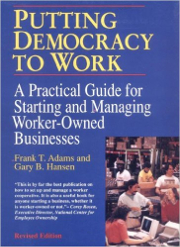
Review: Putting Democracy to Work

PuttingDemocracytoWork

While there are many tens of thousands of books in print about starting and running a traditional capitalist business, very few books have been published specifically about starting and running a worker-owned business, and those books that have been published tend to be relatively old. Previously, I reviewed the worker-ownership guide, We Own Itthat was published in several editions back in the late 1980s/early 1990s, and here I would like to take a look at another guide from around that same era, Putting Democracy to Work, A Practical Guide for Starting and Managing Worker-Owned Businesses, by Frank T. Adams and Gary B. Hansen. Both these business guides were written in a very different time and for a very different business environment, before the age of the internet and before the hyper-capitalist, neoliberal economic model completely conquered the world. When these two guides were first published, the Soviet Union was still with us, and the final revised edition of Putting Democracy to Work  from 1992 would have been written shortly before the end of the Cold War. But as I argued in my review of We Own It, I believe that even though much of the specific information in these guides is now outdated, the general advice they offer is still very valuable, and that they are definitely worth tracking down and reading if you are considering launching your own worker-owned start-up.

Continue reading
Posted in Book Reviews | Leave a comment

Interview: Yochai Gal, Boston TechCollective

humanoid-chaotic-good

Yochai Gal has been instrumental in founding two worker cooperatives: the San Francisco TechCollective, and more recently, the Boston TechCollective in Somerville, MA. Yochai was born in Israel but raised in California and started repairing computers when he was 17. He has long had an interest in worker-ownership, and when he couldn’t find a worker-owned tech business that needed his skills, at 23 years old, he decided to set up his own.

He and his fellow co-owners opened the San Francisco TechCollective in May, 2007, with a 20K line of credit from Wells Fargo, 14K of which they used and then successfully paid off. The business has a storefront in the Mission District of San Francisco out of which they handle consumer and small-business IT support and specialize in data recovery.  The collective currently has six worker-owners and they are successful enough to pay themselves above-average wages and excellent benefits. They are the highest-rated IT company on Yelp in the Bay area.

In 2011, Yochai relocated with his wife to Boston, and in May of 2013 he launched the Boston TechCollective with a new group of co-owners, assisted by a 70k loan from the Cooperative Fund of New England. The Boston collective currently has six worker-owners and hopes to pay off their loan in about another year.

Recently, the two TechCollectives and C4 Tech & Design in New Orleans have partnered to form the Technology Cooperative Federation as a purchasing cooperative, allowing them to compete in purchasing power with larger private IT companies and corporations.

Yochai kindly agreed to an interview by email:

Continue reading
Posted in Interviews | Leave a comment

Credit unions

In order to have a growing and sustainable cooperative business ecology you need at least two things: first, you need a continuous stream of newly founded worker-owned firms entering the ecology, either through conversions or as startups; and second, you need a growing cooperatively-owned financial sector in the ecology, to help these worker-owned firms manage their capital. The Kibbutz experience in Israel has shown that, given the chance, capitalist banks will use their financial leverage to force cooperative businesses to adopt capitalist structures over time; in other words, for purely ideological reasons, capitalist banks have been shown to use restrictive loan terms to progressively force cooperatives to convert back into capitalist businesses. (Simons and Ingram 1997) Capitalist banks don’t trust cooperatives, they don’t like to work with them, and when they do, they often insist that cooperatives restructure themselves to operate more like capitalist businesses as a precondition for loaning cooperatives money. A healthy cooperative economy requires a financial sector that shares its cooperative structure and philosophy so that worker-owned firms have access to investment capital from banks that understand what cooperatives are about and on terms that fit the worker-owned business model. That’s why it is so discouraging to see that the number of credit unions in the United States continues to drastically decline:

credit-unions-over-time
Continue reading
Posted in Research | Leave a comment

Scottish employee-owned firms outperform capitalist firms

Ross Brown at the University of St. Andrews and his colleagues recently published research demonstrating that Scottish employee-owned businesses outperform capitalist firms as measured both by growth in employee numbers and by growth in turnover. It is a small study – just twelve worker-owned businesses are compared with a matched sample of capitalist firms – but nonetheless, it adds to the ever-growing body of evidence demonstrating that worker-owned businesses perform at least as well, and often better, than their capitalist competitors. And it is particularly interesting to see this research carried out in Scotland where worker-ownership seems to be growing unusually rapidly. You can read the full report here:

Brown, R, McQuaid. R, Raeside, R & Canduela, J (2014) “The performance of employee-owned businesses in Scotland: some preliminary empirical evidence.” Fraser of Allander Institute Economic Commentary 37 (3), 108–117.

Posted in Research | Leave a comment

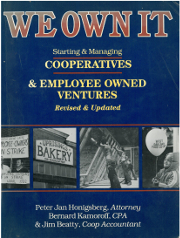
Review: We Own It

we_own_it(small)

This was one of the first books I ever owned on cooperatives and worker-ownership. I bought it in hard-cover in the middle 90s, and it served then as a simple introduction to the practical and legal issues involved in founding a cooperative. There are surprisingly few books on the market today to help with the practical side of running a worker-owned business, so I thought I would reread We Own It and see how well this old guide has weathered the years. You can find used copies fairly easily on the internet, but is it still worth reading?

I reread the revised 1991 edition, and even at that date, the book was old. The first edition came out in 1981, and many of the old black-and-white pictures that illustrate the pages appear as though they were taken sometime in the late 1970s. To be sure, much of the detailed legal advice will probably be well out of date by now, but in general, the authors do an admirable job of clearly and simply explaining the differences between various types of partnerships and corporations, models of cooperatives, and the myriad of tax issues involved in these different business structures. In the USA, the laws governing businesses vary significantly from state to state. Any group planning to start a new worker-cooperative would need to research local laws and possibly hire a lawyer before starting up in any event, so while some of the detailed advice in We Own It might be out of date or not apply in a particular area, all of the basic information presented on different types of business structures will still be valid and very useful today.

Continue reading
Posted in Book Reviews | 1 Comment

Shizuko and Kuniyo Iwane: Japanese Socialist Entrepreneurs

seikatsuclub

In the March 2014 issue of the journal Organization Studies, Aegean Leung, Charlene Zietsma, and Ana Maria Peredo have published a fascinating case study of a Japanese cooperative network that is little-known in the English-speaking world: the Seikatsu Club.

Founded in 1965 in Tokyo as an all-woman consumers’ collective, the Seikatsu Club has grown over the past 50 years into a network of 30 consumers’ cooperatives with 300,000 women members and annual sales of one billion US dollars.  As it grew, the Seikatsu Club also diversified, branching into electoral politics and worker ownership.  In 1979, the Club established the Seikatsusha Network, a grassroots political organization founded to advance the Club’s social and environmental agenda.  To date, the Seikatsusha Network has successfully elected some 150 members to local government.  Then in 1982, the Club established Ninjin, the first of 600 worker-owned businesses in the network that now employ 17,000 women, with a combined total annual sales of 150 million US dollars. (Leung et al. 2014: 427, 450)

Continue reading
Posted in Business Profiles | Leave a comment

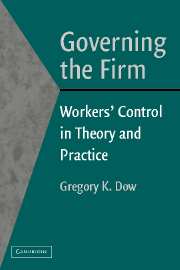
Review: Governing the Firm

GoverningtheFirm

Gregory K. Dow wrote Governing the Firm in order to answer a simple but fundamental question: if worker-owned businesses are typically more productive, more efficient, more stable and fairer than capitalist businesses, why do we still live in a capitalist world?  Worker ownership¹ is increasingly common but it still only represents a tiny fraction of the global economy.  If worker ownership is such a successful and desirably way to organize a business, then why isn’t worker ownership the dominant model?  Why isn’t the worker-ownership movement growing faster and why are we still stuck with corporate capitalism?  Is there perhaps something wrong with how the model is usually implemented?  Is there any way to make setting up a worker-owned business easier, and ultimately, more common?

Dow’s analysis is complex (in a poetic turn, he calls it his ‘causal tapestry’) and he resists naming a single factor to account for the rarity of worker ownership; nonetheless, he places most of the blame on the problem of capital supply:

One reason for a systematic bias toward capitalist firms at the formation stage is that workers have limited personal wealth and cannot easily attract external financing. (p. 208)

Drawing on evidence from worker-collectives around the world, Dow shows that worker-owned firms are rare and fragile, in large part, because they don’t have the same access to capital that capitalist firms enjoy.  Dow demonstrates that where worker-ownership has grown as a movement, worker-owners have found a way around this problem with capital.

Continue reading
Posted in Book Reviews | 1 Comment